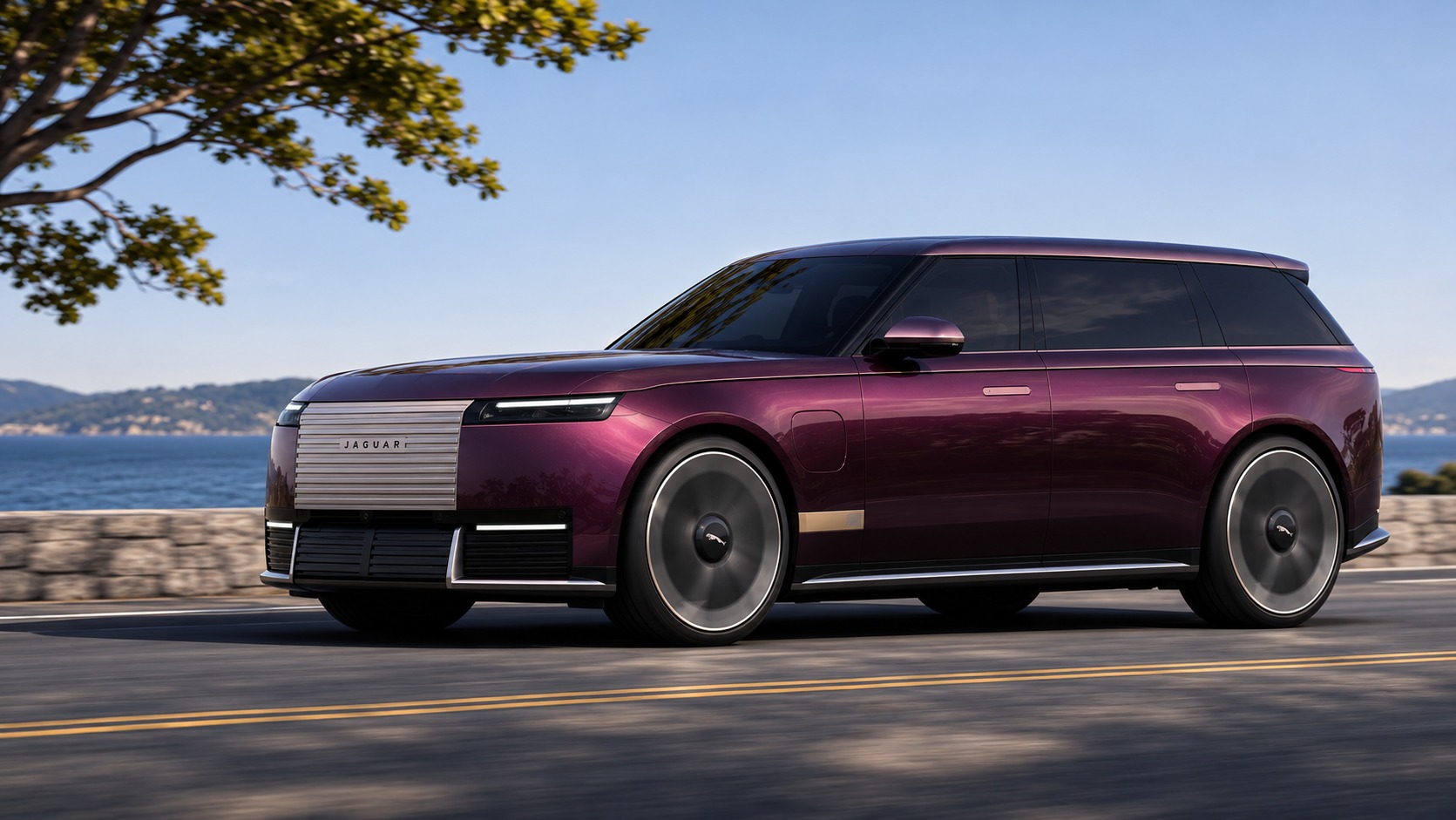
Jaguar Finally Lets Us Inside the Type 01. The Brass Spine Is the Star.
Jaguar's own designers just walked through the Type 01 cabin on the company's YouTube channel. You get four individual seats, a 24-inch driver display, and a brass-effect spine that runs the length of the car. The back row is intimate, to put it kindly.
By Exotic Car TrendsPublished 6 min read
The Type 01 from above: four seats, and a brass-effect spine running the length of the car.
Most new EVs want you to notice the screen. The Type 01 wants you to notice the furniture.
A brass-effect spine runs the full length of the cabin and splits it into four individual seats. It looks less like a conventional interior and more like someone dropped a modern lounge into a very low GT. That is not an accident. Jaguar has been talking about this layout since it first showed the cabin on Aug 12, 2026. On Nov 10, the company's own designers walked through the whole thing on Jaguar's official YouTube channel.
We've already covered the Type 01's exterior, the street reaction, and the Type 02 name that followed it in our earlier story. This one is about the inside.
Chief interior designer Tom Holden calls the spine an architectural statement that creates four individual spaces. From above, the official stills make the point immediately: four seats, a long center line, and brass-inspired rails running front to back.
The inside, as Supercar Blondie put it after watching the walkthrough, is more about length than width. Three brass-effect lines run the length of the cabin, and the same finish shows up along the tops of the doors, complete with a Jaguar leaper stamped into the metal. It is actually anodized, embossed aluminum made to look like brass. I'll still call it brass. Everyone else does.
The leaper, stamped into that brass-effect rail on the door. Yes, I would point this out to passengers.
You sit in it, not on it
Holden is pretty hung up on the driving position, and I don't blame him. "Many modern EV packages make you feel like you're sat on the car and definitely not within it," he said in the walkthrough. "But it's incredibly important with this being a Jaguar that this wasn't the case."
The seats sit low. The dashboard is slim. The cabin shrinks around the driver in that old-school GT way. "You sit very low in this car," Holden told The Times of India. Jaguar's engineers even moved some of the battery cells forward so they could carve out a rear footwell without raising the roof.
The driver's view: a slim dash, a wide OLED, and that little portrait screen on the spine.Four seats, a glass roof, and the spine doing all the talking.
The screens, without the usual tablet wall
In front of the driver is a 24-inch single-glass OLED, the Interactive Driver Display. The essential controls live on either side of the instruments, under one piece of glass. There is no giant center tablet taking over the dash, which already makes me like it more than half the EVs I've sat in.
Instead, a seven-inch, smartphone-style portrait screen sits on the spine for climate, seats, and the everyday stuff. There's another one for the rear passengers. Car and Driver and The Verge both clocked that layout. MotorTrend says they work with the usual swipe, tap, and zoom.
Because the Type 01 has no conventional rear window, Jaguar put a ClearSight camera display at the base of the windshield, at the same height as the door mirrors. It lives in the panoramic soundbar that runs from A-pillar to A-pillar. Jaguar calls that soundbar an automotive first: a full-width, full-range unit, part of a 23-speaker Meridian system, with extra speakers hidden in the headrests for noise cancelling.
The seven-inch spine screen. It looks like a phone, and Jaguar says it works like one too.From the passenger side, the cabin feels long, low, and almost quiet, until you notice how much is packed into that spine.
Hidden cupholders and a wool-blend flex
Jaguar also hid the boring stuff, which I love. Lift a panel in the spine and you get cupholders and a stowage bin, lined in that same brass-effect finish. Concealed compartments, hidden-until-needed tech, little hits of color. It's the kind of detail that makes you wander around the car longer than you meant to.
Open the spine and there's a brass-lined bin with cupholders. Of course there is.
The materials are quietly serious. The cabin uses a wool-blend Kvadrat textile and Ultrafabrics Neograin, plus a recycled-polyester carpet and recycled felt in the stowage areas. Leather seats are still optional. Mary Crisp, JLR's chief designer of materiality, told The Times of India, "We really feel like there are materials other than leather that are luxurious."
Holden put it more bluntly in the walkthrough: "Luxury doesn't always mean more materials. Every material has a role. It has a reason for being there."
The headrest fabric, with a little brass-colored stripe work. This is the part I'd keep running a hand over.
About those rear seats
Here's the catch, and Jaguar is fairly honest about it.
The Type 01 has four doors, but almost everyone who has sat in it calls the back a 2+2. Car Design News said rear space is snug and pretty tight for two six-footers, and the rear doors are slim thanks to the low roof and the rear wheel arch. Car and Driver had a tall colleague struggling to get in. MotorTrend said if you're a 6-footer, kneeroom and headroom are at a premium.
Holden didn't pretend otherwise. The exterior proportions came first. "It wasn't like this car had to tick every single box, because as soon as you start doing that, you end up with a very generic car," he told Car Design News. The floating console and scalloped door panels are the team's attempt to steal back a little space.
I'd sit up front. If you need a Jaguar you can actually load people and bags into, that's probably the Type 02 conversation.
The numbers, quickly
Since people will ask: Jaguar's official peak figure is 1,030 PS, which is 1,016 horsepower, and 1,365 Nm of torque from three motors. That's the most powerful Jaguar road car yet. Officially, it does 0 to 62 mph in 3.2 seconds. Car and Driver estimates 0 to 60 mph in 3.1 seconds.
Supercar Blondie used 1,016 horsepower in the headline and 1,061 horsepower in the body. The official number is 1,016. Our earlier Type 01 story said more than 1,000 horsepower, which still tracks.
The 118 kWh battery and 850-volt architecture are rated for an expected EPA range of up to 400 miles, or about 320 miles if you sit at a steady 75 mph. A 350 kW DC charger can add 200 miles in as little as 13 minutes, or take the pack from 10 to 80 percent in about 22 minutes, according to Car and Driver. There are charge ports on both sides, and MotorTrend says US cars will be able to use Tesla Superchargers.
US pricing starts at $130,000 to $130,500, before destination. Jaguar confirmed a $130,000 North American minimum to CNBC. Car and Driver and The Verge have used $130,500. In the UK, the car starts at £130,000, about $170,000, which is where Blondie's "around $170,000" figure comes from. That is the British price, not the US sticker. In Canada, Auto123 and Autosphere have reported a preliminary 178,000 Canadian dollars for the 1030 trim.
Orders are due to open in early 2027, with first deliveries in the second half of the year, as a 2028 model-year car.
Would I want one?
Yes. Especially from the driver's seat.
The Type 01 cabin is strange in a way I like. It is not trying to win a minivan comparison, and it is not just another slab of screen. It is a long, low, slightly theatrical GT with a brass line down the middle and four little rooms instead of one big one.
Advertisement
Would I put friends in the back for a long trip? Probably not.
Would I climb in, sit low, and go looking for a reason to take the long way home? Absolutely.
Jaguar reserved the Type 02 name on Nov 9, 2026. The paperwork does not confirm a body style, but the brief Jaguar has already given (more practical than the Type 01, same design language, no fight with Range Rover) points at a long, low electric SUV. That is the car we are expecting, and the Type 01 already tells us how it should look.