Porsche Patents a Paddle E-Brake for Handbrake-Style EV Slides
German patent application DE 10 2025 118 784 A1, published Nov 19, 2026, describes two paddles, usually on the steering wheel, that tell a rear electric motor to brake one or both rear wheels to a standstill, or close to it, for a fly-off handbrake-style slide. The filing does not name a model or confirm production.
By Exotic Car TrendsPublished 5 min read
Figures 1 and 3 from DE 10 2025 118 784 A1, published Nov 19, 2026. Left: one rear motor driving both rear wheels. Right: one motor per rear wheel. In both layouts, two paddles on the steering wheel command the braking.
Porsche wants you to pull a paddle and send an EV sideways. A German patent application published on Nov 19, 2026 describes a fly-off handbrake function for battery-electric cars: two paddles tell a rear electric motor to brake at least one rear wheel to a standstill, or close to it. The motor does that work by recuperating, so this slide does not rely on the mechanical friction brakes at the rear axle.
The filing is DE 10 2025 118 784 A1, titled "Vorrichtung und Verfahren zum Bremsen von Hinterrädern eines Fahrzeugs," or "Device and method for braking the rear wheels of a vehicle." It was filed on May 15, 2025, and names Dr. Ing. h.c. F. Porsche Aktiengesellschaft of Stuttgart as the applicant, with Nils Sauvlet of Rutesheim as the inventor. An Offenlegungsschrift is a published application, not a granted patent, and nothing in it commits Porsche to putting the system in a production car.
Two paddles, one job: lock the rear wheels
In rallying, a fly-off handbrake is a familiar way to overbrake the rear axle and put the car into oversteer. Porsche's filing is trying to give a battery-electric car the same tool. The preferred controls are two shift paddles on the steering wheel. The system stays off while both paddles sit in their rest position. Move at least one out of rest, and the braking device, which includes at least one electric machine that also drives the car, is supposed to bring at least one rear wheel to a standstill, or essentially to a standstill. For this maneuver, the filing says, no energy is converted in the mechanical friction brake. The electric machine brakes, or recuperates.
Advertisement
Because an electric machine can be controlled more precisely than a friction brake, Porsche says a target slip at the rear axle can also be regulated. Moving one paddle out of rest is enough, the filing says, to bring the corresponding rear wheel to approximately a standstill. Dosing or modulating the braking torque is not required, but it can be added, with a travel or force sensor on the paddle setting the torque, in particular in proportion to how far it has moved or how hard it is pulled.
Figure 1: a single rear motor (101) drives both rear wheels (102). Two paddles (106) on the steering wheel (108) send their commands through a controller (107).
Figure 1 is the simpler layout: one rear motor for both rear wheels. The two paddles can still be read independently. The controller can apply the torque requested by a given paddle, or add the two requests and send that total to the single machine.
A later paragraph will interest anyone who has used torque vectoring to rotate a car. Porsche says further versions come from a torque-vectoring system at the rear axle, which can put the rear wheels independently into slip and apply an additional yaw moment to the vehicle. The filing says the same function can be carried out when each rear wheel has its own electric machine.
Figure 3: a motor (301) for each rear wheel (302). In this layout, one paddle can command one motor, and the other paddle can command the other.
That is Figure 3. With a motor at each rear wheel, the paddles can brake the wheels individually, one paddle per side. The drawings show the paddles on the steering wheel, but the description also allows two paddles on a footrest for the driver's left foot, or two paddles on the center console. The filing does not describe a conventional handbrake lever.
What Porsche's current EVs already do with regen and slip
The application never names a model. The obvious places to look, for anyone in the US or Canada who already drives a Porsche EV, are the Taycan and the Cayenne Electric. Both already recuperate hard, and both already have rear-axle hardware this idea would lean on. Naming them as context is an inference, not a claim in the patent.
A Taycan GTS during Porsche's January 2025 ice-drift record in Finnish Lapland. Porsche says the instructor used only throttle and steering. This patent was filed later, and it is not how that record was set.
Porsche already knows a Taycan can be held in a slide. On Jan 14, 2025, instructor Jens Richter kept a standard all-wheel-drive Taycan GTS in a continuous drift for 132 laps at the Porsche Arctic Center in Levi, Finland, covering 17.503 kilometers (about 10.9 miles) in 46 minutes. Porsche says he did it with throttle and steering only. The new filing is about adding a handbrake-style tool that record did not use.
The paddles already have a milder regen job. In a 2026 Christophorus piece on the optional E-Shift system, offered on the Taycan lineup for the 2027 model year and standard on the Turbo GT, Porsche engineer Lisanne Schaal says that when E-Shift is off, the paddles let the driver choose lift-off recuperation in three settings: Off, Level 1, or Level 2. That is not a command to lock a rear wheel.
Advertisement
The Cayenne Turbo Electric. Official Porsche material describes one motor on the rear axle, plus Porsche Torque Vectoring Plus, and recuperation of up to 600 kW.
The Cayenne Electric is the closer match to Figure 1. Porsche describes one rear-axle motor, not one motor per wheel, and says the car can recuperate at up to 600 kW, with about 97 percent of everyday braking handled by the motors alone. The Turbo Electric also gets Porsche Torque Vectoring Plus as standard, optional on the S Electric: an electronically controlled rear differential lock, plus targeted dynamic brake actuations at the rear axle. That is not the paddle e-brake in this filing. It is the kind of rear-axle hardware the patent's torque-vectoring paragraph is talking about.
What happens next
Companies file patents to protect ideas, including ideas they never build. This application does not put the system on a named model, and it does not say how a street car in the US or Canada would limit a function that can lock a rear wheel. It was published on Nov 19, 2026, the same day as two other Porsche filings already covered here, a split rear wing that opens a gap for the mirror and a steering wheel whose rim thickens in Sport mode. This story will be updated if Porsche comments, or if a prototype's paddles do more than set regen or a virtual shift.
Analysis
Our take
This is the kind of EV idea that actually gives the driver something to do. Porsche has spent the last couple of years trying to give electric cars more for the driver's hands to do, from E-Shift's virtual gears to ice-drift records meant to prove a Taycan can play. A paddle that asks the rear motor to break the rear axle loose is more interesting than another soundtrack. The promising bit is the control: a motor that can be held to a target slip, and that drops the command the moment the paddle goes back to rest, is a finer tool than a mechanical fly-off lever.
A published application should not be overread. There is no model and no street mode versus track mode. If this ever reaches a Taycan or a Cayenne Electric sold in the US or Canada, Porsche would likely fence it off in a clearly labeled drift or track setting. Until then, this is a sharp idea on paper, from the same week of filings as the split wing and the expanding wheel, and not a feature you can order.
German patent application DE102025119020A1, published Nov 19, 2026, describes a rear wing made of two halves that sit flush in the deck and open a gap down the middle as they rise, so the driver can still see through the rear-view mirror. Each half can tilt on its own. The filing does not name a model or confirm production.
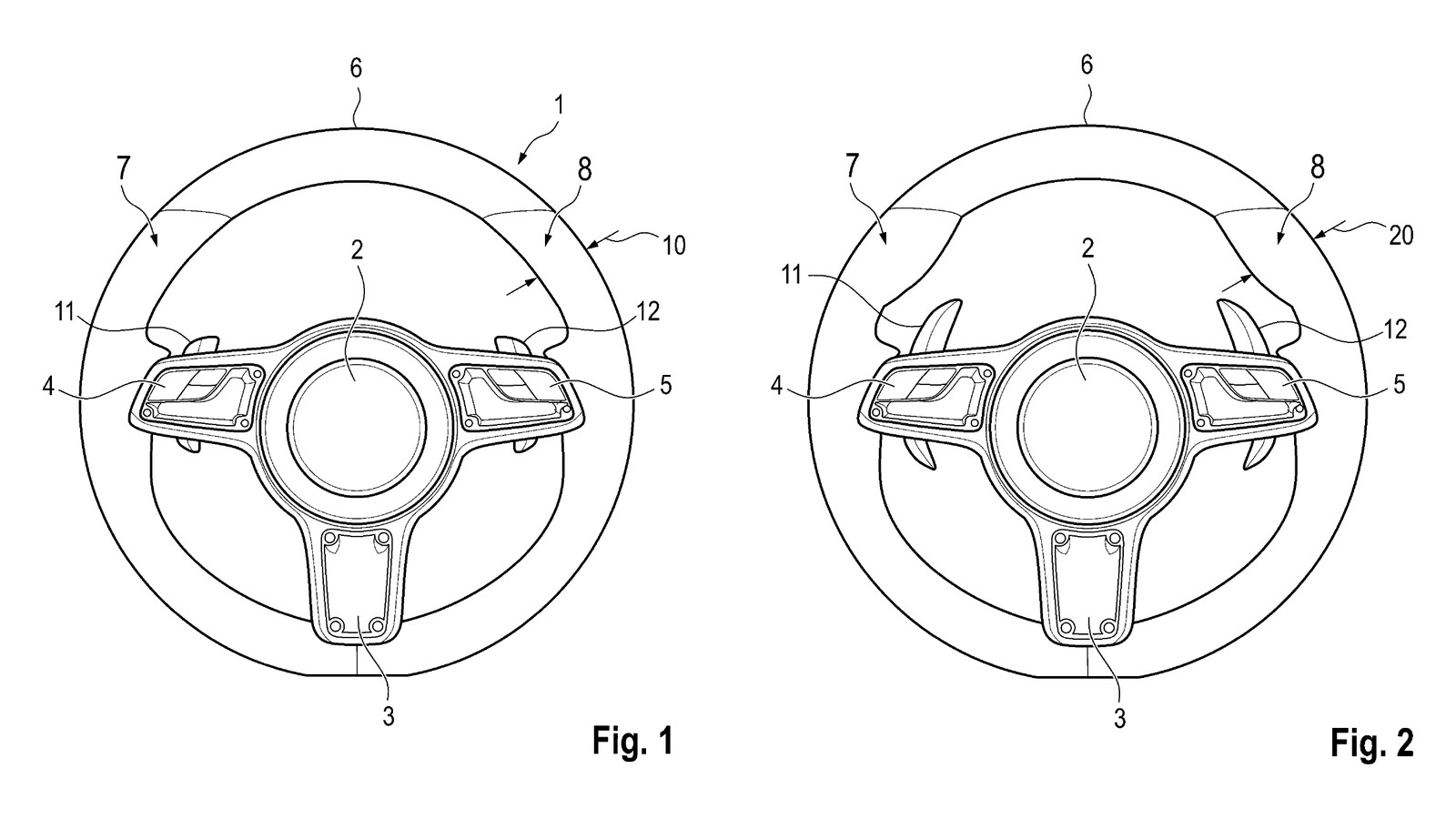
Porsche's German patent application DE 10 2025 119 261 A1, published Nov 19, 2026, describes a steering wheel whose upper rim swells with hydraulic fluid while the shift paddles slide out to meet your fingers. Sport mode, a button, or your driver profile could trigger it, and the same fluid could cool or warm the rim.
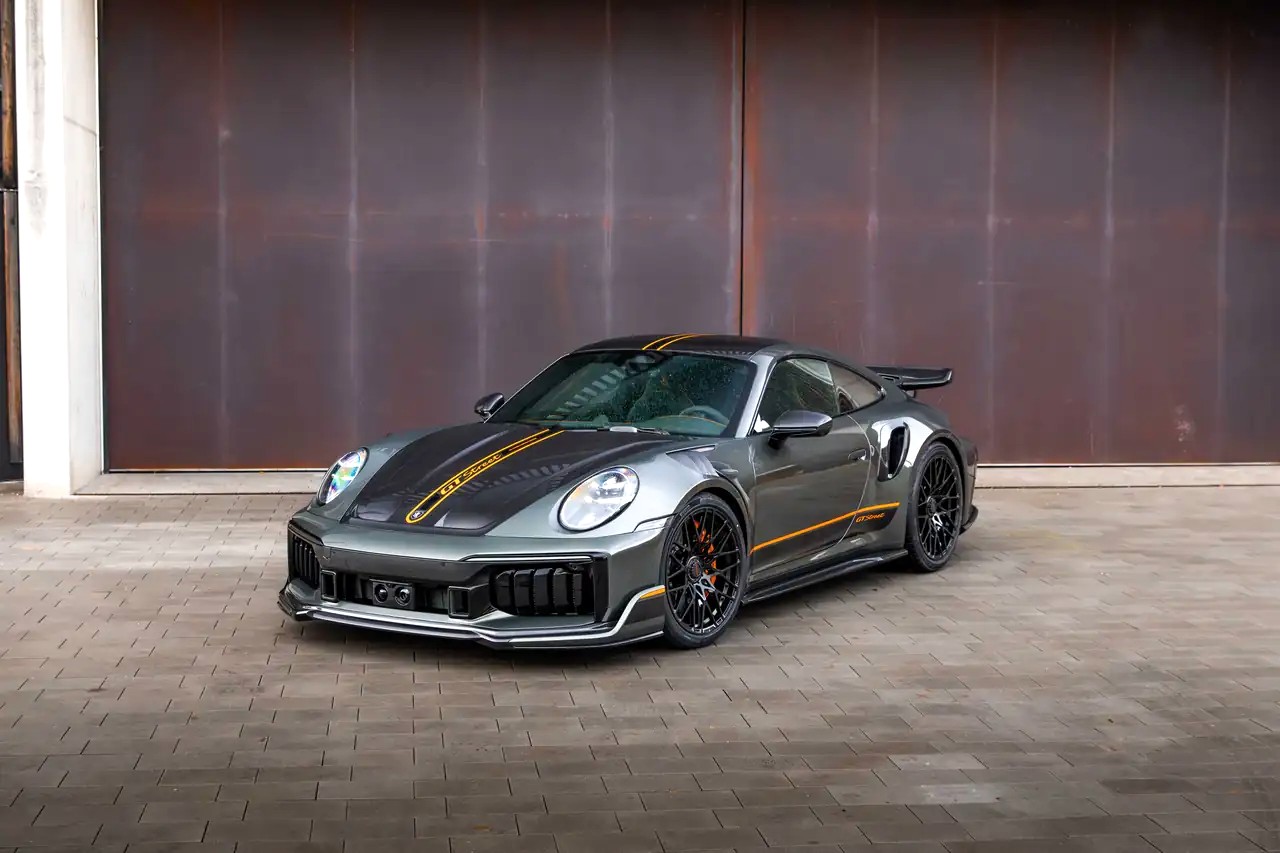
TECHART revealed its fifth-generation GTstreet on Nov 25, 2026: a 992.2 Porsche 911 Turbo S with 811 PS (799 horsepower), 693 lb-ft, a 930 Turbo-style Tea-Tray wing, and a run of just 100 numbered cars, with first deliveries before Christmas.