Porsche's reset under Michael Leiters: fewer cars, higher prices and a Mission S supercar above the 911
Profit collapsed in 2025, China keeps shrinking and the new CEO wants a smaller, more exclusive Porsche. The Mission S concept, revealed October 15 in New York, is the first look at a car that sits above the 911.
By Exotic Car TrendsPublished Updated 12 min read
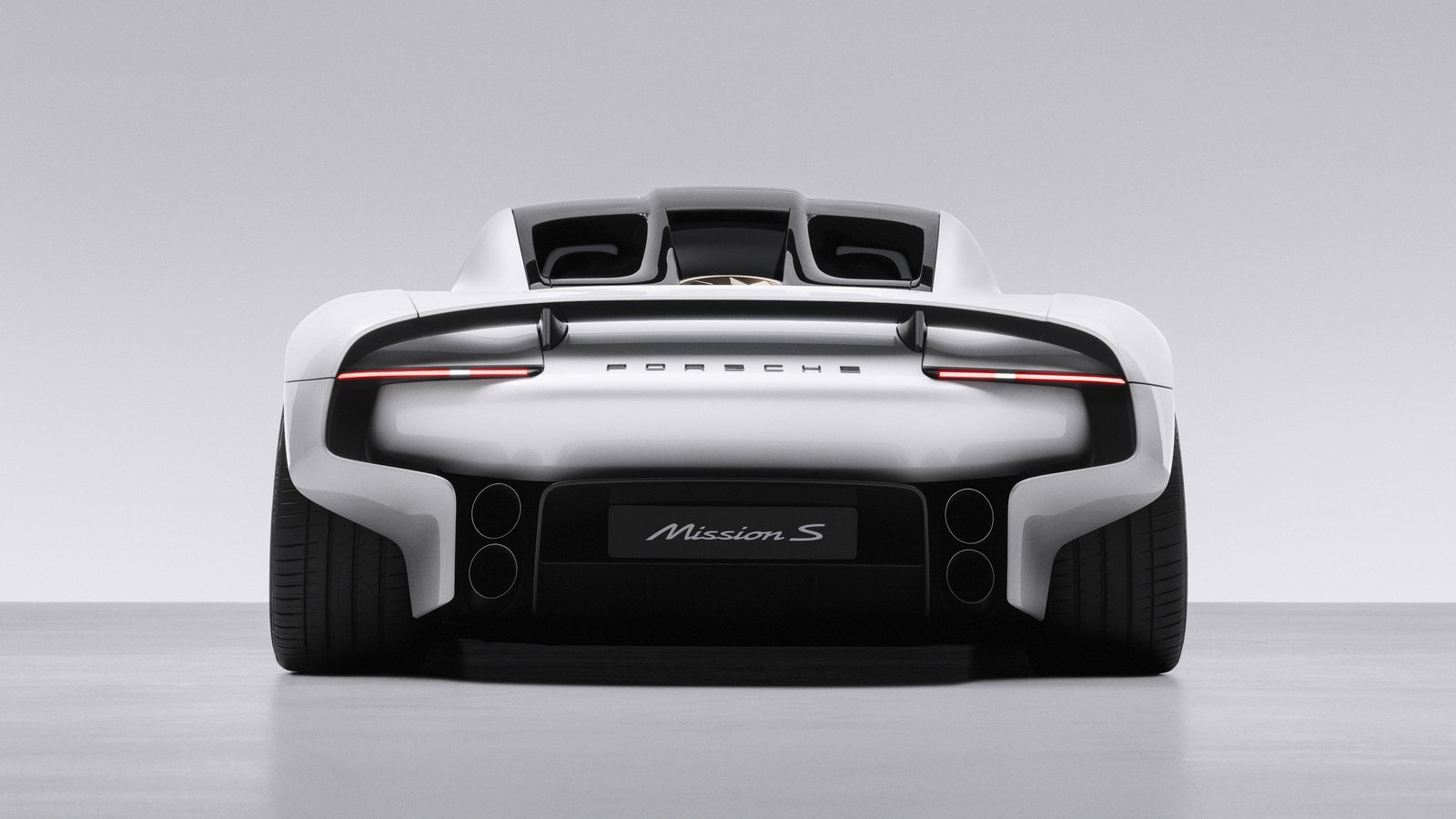
The Porsche Mission S vision model in New York, where Porsche revealed it on October 15, 2026.
Porsche has spent most of 2026 explaining how a company that earned €5.64 billion in operating profit in 2024 earned just €413 million in 2025. On October 7 its new chief executive, Michael Leiters, laid out what comes next: a smaller, leaner and more expensive Porsche, with a mid-engined super sports car sitting above the 911 for the first time. The first look at that car, the Mission S concept, was revealed in New York on October 15.
For buyers this is the biggest change in Porsche's direction in a generation. It tells you where prices are heading (up, at the top of the range), what's being cut (model variants, jobs, side businesses) and what's still undecided, which is almost everything about the Mission S itself.
How Porsche got here
The numbers are stark. In its 2025 annual results, Porsche reported revenue of €36.27 billion, down from €40.08 billion, and 279,449 deliveries, down 10%. Operating profit fell from €5.64 billion to €413 million, a margin of 1.1% against 14.1% a year earlier. About €3.9 billion of the damage was one-off: roughly €2.4 billion to rework the product plan and shrink the company, about €700 million tied to its battery business, and about €700 million in US tariffs.
Advertisement
The product rework is the heart of it. Porsche bet heavily on electric cars and demand didn't arrive on schedule. Its first-half delivery report blamed the slower-than-expected EV ramp-up, the end of US tax incentives and the end of the gas 718 Boxster and Cayman for a 16% drop in deliveries. The third quarter didn't change the picture. Porsche delivered 178,532 cars in the first nine months, down from 212,509 and still 16% lower, and said it is sticking to a 'value-oriented' sales strategy that keeps supply in line with demand. China, once the growth engine, fell 33% to 21,493 cars, and Porsche told just-auto it is putting the brand's long-term health ahead of volume there. North America, now Porsche's largest region, fell 13% to 56,088.
Porsche deliveries by region, January to June. Chart by Exotic Car Trends from Porsche's July 9 release.
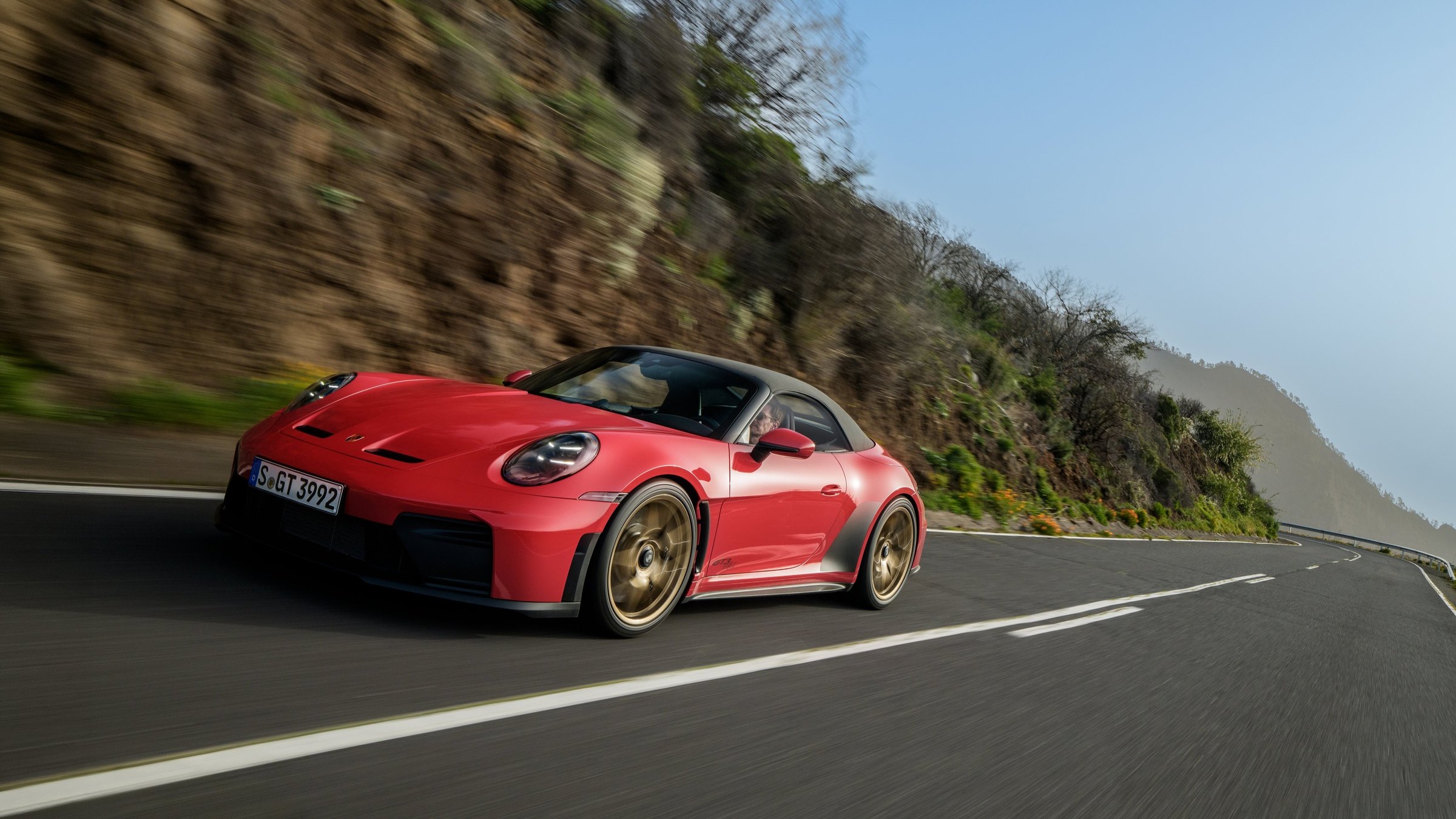
There's one bright spot that matters to enthusiasts: 911 deliveries rose 19% in the first half, to 30,534, with what Porsche called a significant share of GTS, Turbo and GT models. In the US the gap is wider. Porsche Cars North America's third-quarter report shows 11,778 911s delivered through September, against 8,872 a year earlier, while total US deliveries fell to 49,038 from 57,099, mostly because the 718 has run out. The sports cars aren't the problem. Cost-cutting started showing up in the first half, when operating profit rose to €1.35 billion from €1.01 billion, Porsche said.
The first full results since the plan was announced, released October 27, point the same way. Porsche's nine-month report shows revenue down 5.9% to €25.28 billion, a much smaller drop than the 16% fall in deliveries, which Porsche credits to higher prices and a bigger share of expensive models. Operating profit was €1.74 billion, or 6.9% of revenue, against just €40 million a year earlier, when restructuring cost about €2.7 billion. This year's restructuring bill so far is about €500 million. Reuters reported that the 911 was the only Porsche model whose sales rose over the nine months, up 12%, and that Jefferies analysts put third-quarter profit alone at more than 10% of revenue, better than expected.
Not all of the improvement will repeat. Selling its stakes in Bugatti Rimac and the Rimac Group in September brought in €984 million, while US tariffs cost about €200 million in the third quarter. Porsche kept its full-year forecast of €35 billion to €36 billion in revenue, with operating profit of 5.5% to 7.5% of revenue. Finance chief Jochen Breckner told analysts that Audi's planned Georgia plant won't lead Porsche to build cars in the US, since it would still have to ship in engines and other parts and pay for two sets of suppliers (Reuters). Citi analysts, quoted by CNBC, called Porsche's underlying profit resilient and ahead of its German luxury rivals, but still expect 2027 to be the low point, with the recovery starting in 2028.
Leiters took over in January. He ran McLaren until its merger with Forseven in 2025 and, before that, was Ferrari's chief technology officer. Autocar reports that McLaren's former chief designer, Tobias Sühlmann, followed him to Porsche. No previous Porsche boss has run a company that sells cars the way Ferrari does, and it shows in the plan.
The plan: value over volume
The strategy is called Sportwagenschmiede '35, roughly 'sports car forge 2035', and was presented at Porsche's Capital Markets Day at its Weissach development center. Porsche's own summary and reporting by evo, newmobility and Automotive World agree on the main points:
Break even below 200,000 cars a year. Leiters said many parts of the company had been built for 350,000 (newmobility).
About 20% fewer model variants, with about 30% more sales per variant.
Higher prices at the top. Porsche wants the average price of its top models up about 20% in the medium term, and sales from its Sonderwunsch one-off and few-off program up sixfold.
More expensive models. A mid-engined super sports car platform above the 911, more 911 derivatives, and a possible SUV above the Cayenne.
Deep cuts. 40% fewer management positions, a workforce about 25% smaller in direct and indirect roles, and 9,000 job cuts already agreed with employee representatives.
Gas engines stay. Porsche says it's investing in combustion and plug-in hybrid drives alongside next-generation batteries. A gas and plug-in hybrid small SUV arrives in 2028, the same year the electric 718 has its first full production year.
evo added a telling detail from Leiters' presentation. Buyers of Porsche's 10,000 most expensive cars spend about €270,000 on average today, and Porsche wants that closer to €330,000. The benchmark on the slide was Ferrari, at about €440,000 per car. Porsche has also raised its stake in Manthey Racing to 67%.
How high the top of the 911 range could go
The plan also put numbers on how far 911 prices can stretch. At the Capital Markets Day, Car and Driver reported, Porsche said today's 911 GT3 costs about 53% more than a base 911 Carrera and the GT3-based 911 S/C about 95% more, and that future GT cars could cost more than 200% more than a base 911. On October 23, Alexander Fabig, Porsche's vice president for product and individualization, repeated that last figure in an interview with Automotive News: 'Future products could exceed a 200 percent price premium over the base model.'
Porsche didn't name a car or a price. Road & Track did the math: with the base 911 starting at over $135,000, three times that is a 911 at $400,000 or more, well above the roughly $300,000 the 992.1 S/T started at. R&T points out Porsche has badges in reserve for such a car, such as GT2. The Supercar Blog notes there's no confirmation of a $400,000 911, and that's the right way to read it: a stated ceiling, not an announced model.
We break down what a $400,000-plus 911 would mean, and where today's used GT 911 asking prices already sit against it, in A $400,000 911?
Fabig also gave Automotive News the size of Porsche's bespoke and heritage business, and the figures match what Porsche showed at the Capital Markets Day, per Car and Driver. Sonderwunsch, the one-off program behind this year's Flachbau RS, has 15 one-off cars underway, priced from just under $2 million to about $15 million. The factory recommissioning program for the Carrera GT has finished 11 cars, has 16 more in work and 21 waiting, at about $500,000 to $800,000 per car by Fabig's figures, or about $506,000 to $845,000 in Car and Driver's conversion, not counting the car itself. Of the 1,270 Carrera GTs built, that's 48 cars through the factory so far or in line.
The Mission S: what's confirmed and what isn't
Confirmed: Porsche is developing a super sports car platform, and the first car on it will be mid-engined and sit above the 911. The Mission S concept previews what that car might look like. It will be shown on October 15 in New York. Porsche's second teaser, reported by Car and Driver on October 9, shows an 8,000-rpm redline. Two days before the reveal, Leiters added more. Autocar reported on October 13 that he said the car will be combustion-only, with no hybrid or electric version, and mechanically separate from Lamborghini's and Audi's mid-engined cars, though some parts could still be shared across the group. After the reveal on October 15, though, Porsche told Car and Driver that the future model line will support gasoline, hybrid and plug-in hybrid powertrains, with no fully electric version, so the combustion-only description no longer holds. Top Gear reported the same day that it will be a full production supercar, not a limited edition like the 918 Spyder, and the first Porsche designed under Tobias Sühlmann, design chief since February.
We are developing a super sports car platform, and we intend to use it as the basis for a new mid-engined car, a car that will sit clearly above the 911.
Michael Leiters, speaking to evo and other media at Weissach
Not confirmed: the exact engine, power, price, production numbers and timing. Porsche's own release calls it a 'potential' platform. Car and Driver lists the Ferrari 849 Testarossa and McLaren 750S as likely rivals, and evo calls it 'undoubtedly a Ferrari rival'. The Park and Drive indicators in the second teaser point to an automatic, most likely Porsche's PDK dual-clutch, as carandbike and HT Auto noted, but Porsche hasn't said.
The engine is where reporting splits. Car and Driver reports rumors of a flat-eight, which would be unique among today's supercars. Automotive News, as summarized by HotCars on October 11, reports that the project, known internally as S1, would instead pair a V8 with a heavily modified 911-based structure, and that Leiters is personally backing it. autoevolution says either layout is possible and points out that the obvious V8 within the Volkswagen Group is the flat-plane unit Lamborghini developed for the Temerario, which also powers the Audi Nuvolari. It also cites a rumored production price of around €500,000. Motor1, as cited by HotCars, reports a dedicated mid-engine architecture with a combustion engine rather than the electric drive of the 2023 Mission X concept. Leiters' latest comments cut against that last idea. If the car is mechanically separate from Lamborghini's and Audi's mid-engined models, as Autocar reports he said, a straight lift of the Temerario V8 looks unlikely. He didn't rule out shared parts, though, and he didn't say what engine it will use.
Some of this is now clearer. The car is gas-only and, per Leiters, not a reskinned Lamborghini or Audi. What's still open is the engine itself, flat-eight or V8, and how much of the 911 sits underneath. None of the engine reports is confirmed, and October 15 should settle at least some of it.
It also matters what the Mission S isn't. Porsche's last two halo cars, the Carrera GT and the 918 Spyder, were limited runs that came and went. Top Gear reports this one won't be: it's planned as a full production car. That means a permanent tier above the 911, the way mid-engined cars are the core business at Ferrari and McLaren.
The tariff squeeze
Porsche builds no cars in the US. EU-built cars pay a 15% US tariff under the 2025 US-EU deal, and a May 2026 threat to raise that to 25% hasn't taken effect, according to the Suspension auto tariff tracker. Road & Track, citing Automotive News, reported that Porsche paid about $811 million in US tariffs in 2025, and that Leiters called US production 'compelling, but it's a huge investment.' Any US plant would most likely build Cayennes and Macans, so 911 and Mission S buyers should expect the tariff to stay in the price.
Market perspective: our 911 baseline
Exotic Car Trends started tracking 911 asking prices in the US and Canada on October 10, and counted about 1,200 listings on October 11. That's too new for trends, but it shows where the top of today's range sits, and that's the territory a car above the 911 has to clear:
Advertisement
992 GT3 RS: 97 cars, middle asking price about $511,000.
991.2 GT2 RS: 84 cars, about $801,000.
992 S/T: 8 cars, about $677,000. 992 Sport Classic: 12 cars, about $652,000.
992.2 GT3: 87 cars, about $340,000. 992.2 Turbo S coupe: 62 cars, about $365,000.
These are asking prices, not sale prices, and we'll report how they move after the reveal. Live numbers are on the Porsche dashboard.
For scale, here's where today's top 911s sit on the used market. On October 24 we counted 1,331 911 listings in the US and Canada. The 992.1 S/T had a middle asking price of about $699,000 across 13 cars, the 992.1 Sport Classic about $648,000 across 13 cars, the 991.2 GT2 RS about $800,000 across 93 cars, and the 992 GT3 RS about $500,000 across 124 cars. These are asking prices, not sales. A new 911 at $400,000 or more would cost close to what a used GT3 RS asks today.
Analysis
Our take
The diagnosis is right. Porsche's problem was never the 911. It was everything it tried to sell in volume around it, especially electric cars in China. Shrinking to the demand that actually exists, and charging more for the cars people wait for, is the Ferrari playbook, and Leiters knows that playbook better than anyone who has run Porsche.
But 'value over volume' cuts both ways. It's good news if you already own a limited Porsche: fewer variants and tighter supply tend to support values. It's bad news if you're trying to get in. Porsche is openly planning higher prices at the top, more paid personalization and, according to evo, an electric 718 at a considerably higher price than the old car.
On the Mission S, keep expectations in check. A concept is a statement of intent, not a product. Leiters has already answered two big questions, gas-only and a regular production car rather than a limited run, so what to watch on October 15 is the rest: the engine, a timeline and a price. A high-revving gas mid-engined Porsche with a firm date would take buyers from Ferrari and McLaren. A vague one is still a design study.
Analysis
What it means for buyers
Shopping a new 911 GT car: expect allocations to stay tight and prices to keep rising, not falling, under this plan.
Watching for a range-topping 992.2: Porsche has said future GT cars could cost more than three times a base 911. Nothing is announced, so there's no list to get on yet.
Owning a GT2 RS, GT3 RS or Sport Classic: a new tier above the 911 doesn't make these less special, but it will compete for the same buyers. We'll watch for any softening after October 15.
Waiting for a Mission S: there's nothing to order yet. Don't pay a premium to get on a list for a concept.
Looking at a used 718: the gas Boxster and Cayman ended production in October 2025 and the replacement is electric. A good gas 718 is now the end of a line.
What happens next
October 15: Porsche revealed the Mission S in New York as a permanent mid-engined line above the 911, without specs or pricing. See Porsche Mission S revealed.
Rest of 2026: Porsche kept its full-year forecast on October 27: €35 billion to €36 billion in revenue, with operating profit of 5.5% to 7.5% of revenue. Analysts at Citi expect 2027 to be the low point before profits recover from 2028.
2028: first full production year of the electric 718, and launch of the new gas and plug-in hybrid small SUV.
Porsche's product chief told Automotive News that future GT cars could carry a price premium of more than 200% over the base 911. In the US that points to a $400,000-plus 911. On the used market, the rarest GT 911s are already asking that much.
Porsche pulled the cover off the Mission S on a Queens pier on October 15. It's a design study for a permanent mid-engined model line above the 911, with a 917-style cooling fan, 928-style wheels and no center screen. Engine, power and price are still unannounced, but CEO Michael Leiters says it will offer gasoline, hybrid or plug-in power, no EV, could take a manual or PDK, and will cost 'much more' than a 911.
Updated Nov 20, 2026 · Published Oct 15, 2026 · 10 min read
The most talked-about new supercars of 2026 share something old-fashioned: a clutch pedal. Here's what's real and what's simulated, what they cost, how few will be built, and what the market says analog cars are worth.
Updated Oct 29, 2026 · Published Oct 11, 2026 · 8 min read